
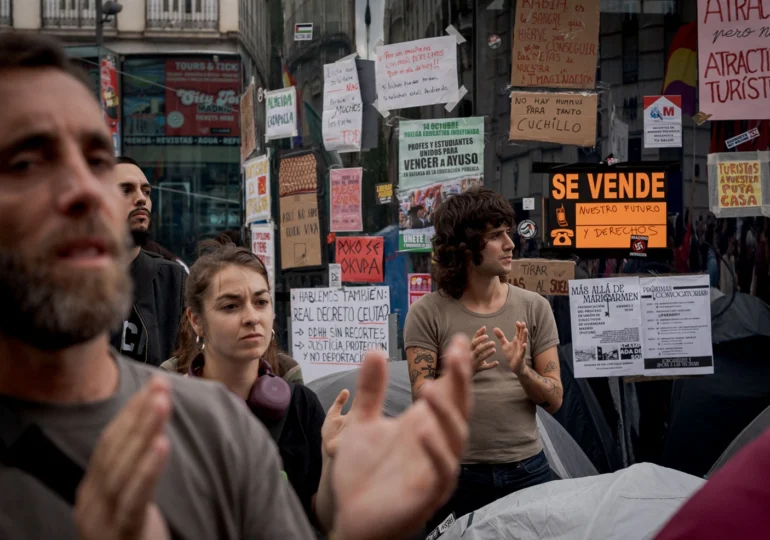
Tens of thousands of protesters started marching in Madrid and other cities in Spain on Saturday for the right to housing, a day after parliament rejected a series of measures presented by the government to address the real estate crisis. The demonstration in Valencia turned violent.
The protests, planned before Friday’s parliamentary vote, were triggered about ten days ago following the eviction of 87-year-old retiree Maricarmen Abascal from the Madrid apartment where she had lived her whole life. She has become a symbol of the housing crisis affecting Spain for several years, as reported by AFP, cited by Agerpres.
In Madrid, where around a hundred activists have gathered for a week in the tourist square Puerta del Sol, participants in the march, carrying a banner with the message "Towards a general strike," are expected to head to another important square in the city center.
"What is felt in the streets is a new energy, an energy that we have not seen in a long time, an energy that demonstrates that eight days of popular power can achieve much more than eight years of progressive governance," said Valeria Racu, one of the spokespersons for the Spanish tenants' union behind the protest movement.
Incidents in Valencia
In Valencia, clashes occurred between demonstrators and law enforcement.
Several protesters broke through the police cordon and threw metal fences at the gendarmes:
Where Did the Wave of Protests Start From
The current crisis was triggered by the eviction last week of octogenarian Maricarmen Abascal, who was forcibly removed from the apartment where she had lived in Madrid for nearly 70 years, after the real estate company that bought it wanted to increase her rent by 275%.
The images of the woman being taken out of her home on a stretcher after the police broke the apartment door sparked outrage in Spain, and Prime Minister Pedro Sánchez promised measures to support those affected by the housing crisis.
The eviction of octogenarian Abascal has triggered popular anger against rising rents, which have doubled in the past decade and reached nearly 1,200 euros per month, equivalent to about 99% of a young person's average salary. Under these conditions, many Spaniards continue to live with their parents even after the age of 30.
What the Government Tried to Do
Pedro Sánchez tried on Friday to obtain a majority in parliament, but without success: the Popular Party (right-wing), Vox (far-right), and Junts (Catalan nationalist party) voted against both government bills.
The Sanchez government tried to address three major issues:
- prohibiting the eviction of vulnerable tenants until 2030;
- freezing existing rents for two years;
- introducing stricter rules for short-term rentals.
The opposition argued that housing "does not become cheaper through decrees," but through building more houses.
The rejection of the government's proposed measures has reignited debates about the end of the legislative term, scheduled for 2027. According to the Spanish press, socialist Prime Minister Pedro Sánchez has given himself a few days to assess the situation and decide whether to call early elections or not.
T.D.