
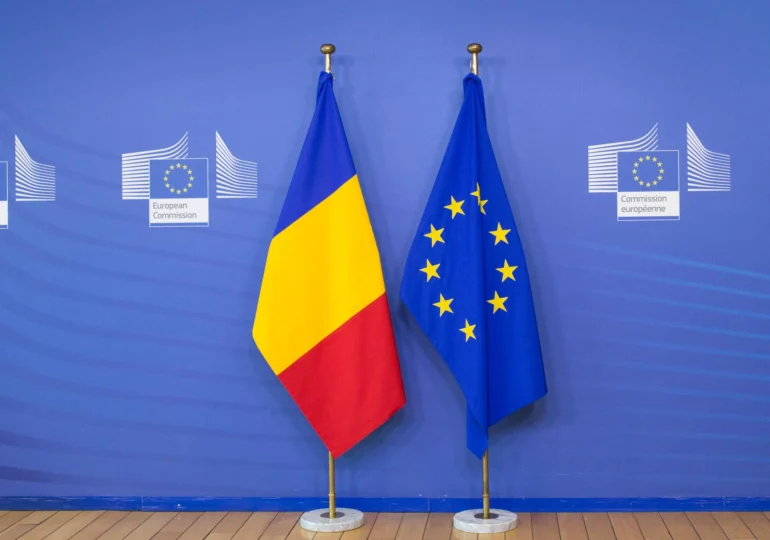
Romania has only capitalized on approximately 20-30% of the opportunities offered by joining the European Union, estimates Vasile Pușcaș, former chief negotiator of Romania with the EU. He believes that the country has made modest progress in the European integration process and criticizes the lack of a development strategy, how European funds were used, and how the political class managed the post-accession period.
In an extensive interview with journalist Oana Despa from News.ro, nearly 20 years after Romania’s accession to the EU, Pușcaș also talks about the large number of Romanians leaving abroad, which he considers one of the biggest losses for the country. Regarding the adoption of the euro, the former chief negotiator estimates that Romania would need another decade to be ready to approach the eurozone.
Vasile Pușcaș, who led the accession negotiations from 2000 to 2004, says that Romania’s entry into the European Union was supposed to mean more than the country’s participation in European institutions. The objective was for European development policies to be implemented in the country to improve the standard of living of the population.
In his opinion, the governments that succeeded after 2007 did not have a clear strategy to capitalize on the advantages of EU membership. „Photo opportunities at the decision-making table are not enough to argue that Romania has integrated into the interdependencies processes of the European Union,” says Pușcaș.
He recalls that at the end of 2004, in his assessment, Romania was at a level comparable to Poland. Subsequently, the Romanian economy recorded growth, but the country did not exploit all the competitive advantages it could obtain through a development strategy. „Romania joined the European Union, but took modest steps on the path of European integration,” says the former chief negotiator.
In relation to the development potential Romania had at the time of accession, Pușcaș estimates that the country has capitalized on approximately 20-30% of the opportunities offered by European integration.
### Romania joined the EU, but integration lagged behind
Vasile Pușcaș considers that the adoption of the euro could become a new national project, but warns that Romania is far from this goal. He points out that, at the end of the accession negotiations, there was hope that Romania could switch to the euro approximately five years after joining the EU, provided that the necessary economic criteria were met.
Pușcaș argues that the objective was abandoned as early as the first part of 2005, against the backdrop of the choices of interest groups, including political ones.
Currently, he believes that Romania must first adopt a sustainable development strategy, which should be followed regardless of the parties in power. „Considering the current level of economic-financial, but also socio-political, disarray in Romania, I believe we would need a decade to fix our house to become healthy in the antechamber of the Eurozone,” says Pușcaș.
### Political class and abandoned national projects
Pușcaș also criticizes the fact that Romania has had several attempts to build a national project, but these have not been carried out to completion. „It was not the lack of strategic thinking in Romania, but the will to use it for the benefit of the entire Romanian society,” says the former chief negotiator.
He believes that this situation has affected the citizens’ trust in political parties, which many have come to perceive as groups concerned with their own interests.
Pușcaș also criticizes the deterioration of the political culture, for which he attributes responsibility to the political and intellectual elite in Romania.
Instead, he appreciates the efforts of a significant part of the entrepreneurial environment, which, in his opinion, has largely managed to develop through its own efforts, without the strategic support that the state should have provided.
Despite the critical assessment, the former chief negotiator says he looks optimistically towards Romania’s next decades in the European Union. „But I also look optimistically towards Romania’s next decades in the European Union!” concludes Vasile Pușcaș.