

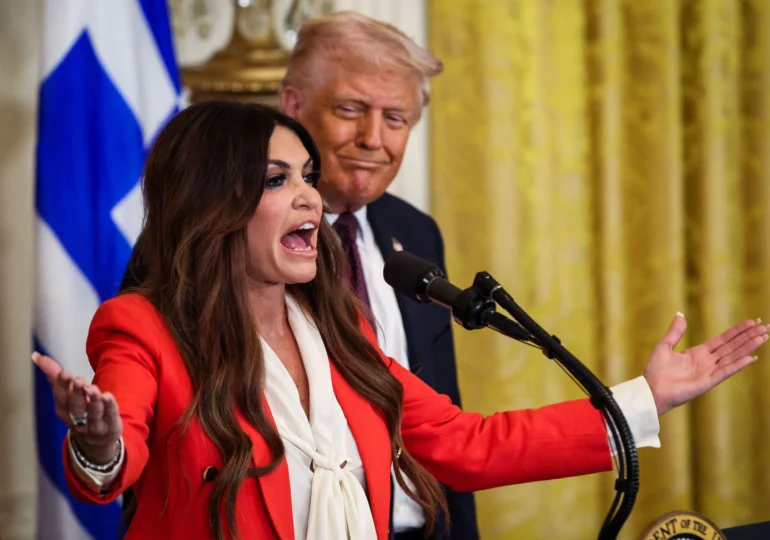
Several Democratic congressmen from the Senate and House Foreign Affairs Committees have requested the State Department to investigate the behavior of the U.S. Ambassador to Greece, Kimberly Guilfoyle.
They cite the Wall Street Journal investigation into the ambassador’s efforts to promote gas agreements concluded by a Greek company in Southeastern Europe.
New Hampshire Senator Jeanne Shaheen, the top Democratic member of the Senate Foreign Relations Committee, raised these concerns in a letter sent Thursday to Secretary of State Marco Rubio, as reported by WSJ.
She complained about what she described as "misuse of an official position" by Guilfoyle, including the involvement of a registered lobbyist in meetings with foreign officials and the promotion of a Greek company represented by him, as well as the joint venture the firm holds with a state-supported Greek company.
"Such actions affect the credibility of the U.S. abroad and risk undermining American diplomacy," Shaheen wrote.
Gregory W. Meeks, the Democratic leader of the House Foreign Affairs Committee, sent a letter to Secretary of State Marco Rubio, expressing concern about the conduct of the U.S. Ambassador to Greece, Kimberly Guilfoyle.
In the letter, Meeks asks Rubio for explanations regarding information suggesting that Ambassador Guilfoyle had threatened that the United States could use its influence to undermine the democratic and sovereign government of Greece, citing Romania as a precedent.
Additionally, she is said to have promoted the commercial interests of a Greek construction and energy company in official diplomatic meetings and repeatedly allowed a registered lobbyist for that foreign company to participate in high-level meetings with U.S. government officials and official representatives of other states.
Meeks called for the ambassador's dismissal if these accusations are confirmed.
"According to a Wall Street Journal investigation published on September 25, 2026, Ambassador Guilfoyle allegedly told participants at a dinner in March, attended by Greek and American officials, while discussing the imminent collapse of the government led at the time by Romanian Prime Minister Ilie Bolojan, that the United States could provoke similar political changes in other countries, including Greece.
This statement raised public concerns in both Greece and Romania regarding the possibility of the U.S. government intervening in the democratic governments of its NATO allies. Opposition parties in Greece publicly demanded explanations from the government in Athens regarding the reported statements.
The same investigation raises distinct issues regarding Ambassador Guilfoyle's relationship with Christos Marafatsos, a registered lobbyist representing the Greek construction and energy company Aktor Group. Federal lobbying documents cited by the Wall Street Journal show that Aktor paid Marafatsos $160,000 by June 2026 to establish connections with, among others, the State Department, the Department of Energy, and the Executive Office of the President.
The WSJ also reported that Marafatsos accompanied Ambassador Guilfoyle to numerous official meetings of the U.S. Government, including meetings with foreign heads of state and other high-ranking officials, and some participants were not informed that he was a lobbyist paid by Aktor. According to reports, some foreign officials even mistook him for the ambassador's chief of staff," Meeks' letter stated.
He emphasizes that these concerns are exacerbated by information indicating that Ambassador Guilfoyle promoted energy projects of Aktor or its affiliated companies in official meetings held in Southeastern Europe.
What the Ambassador said
Kimberly Guilfoyle, the U.S. Ambassador to Greece, allegedly mentioned the imminent fall of the Bolojan government in a dispute with the Greek Energy Minister. "We can do this to any country we want. We can do it here too," she reportedly told those present, according to the Wall Street Journal.
The conversation took place in March at a dinner in Athens attended by Greek and American officials. Guilfoyle got into a dispute with Greek Energy Minister Stavros Papastavrou in front of other guests.
According to a person present and others who were told about the episode, the ambassador referred to the imminent fall of the Romanian government and said, "We can do this to any country we want. We can do it here too." Papastavrou replied that the U.S. cannot replace the Greek government, elected by citizens, as reported by Wall Street Journal.